Spring Training Camp 2026: Seven Days, 500km, and One Very Steep Wake-Up Call
Watch the full camp video here: https://youtu.be/vcH1L5Gd8R0
There's a particular kind of suffering that only a training camp can deliver. Not the sharp, brief agony of a hard interval — that's over in minutes. Camp suffering is sustained. Cumulative. It builds across days, layers onto itself, and by day three you're grinding up a 25% gradient on legs that already feel like someone replaced the muscles with wet cement.
That's what five of us signed up for in Hay on Wye this April. And honestly? Every horrible minute of it was worth it.
The numbers, since you'll ask
Seven days. 500km. 26 hours in the saddle. 1,264 TSS.
To put that last one in context: most riders accumulate somewhere between 50-100 TSS on a hard training day. We were averaging around 180 per day. By day four your legs know about it. By day seven, your legs have filed a formal complaint.
Day 1: Shock and Awe
The Kilverts Hills route was not chosen by accident. The name sounds almost quaint, doesn't it? Kilverts. Like something out of a children's book. It is not like something out of a children's book.
We used Day 1 to establish the tone of the week — which is to say, we established that there would be no easing in, no gentle warm-up days, no "let's save something for later." Later was going to be equally brutal, so we might as well start as we meant to go on.
By the time everyone reassembled at the bottom of the first proper climb, the message had landed: this camp is going to hurt.
The Gospel Pass: highest road in Wales, climbed three times
If you've never ridden the Gospel Pass, it sits at the top of the Black Mountains in the Brecon Beacons — the highest road in Wales. It is, in the best possible way, not what you'd call welcoming.
We climbed it three times across the week. The first time you're taking it in. The second time you're managing it. The third time you're just surviving it, running on spite and the knowledge that there's a descent waiting at the top.
Fortunately, all three ascents came with sunshine — which in Wales in April feels almost suspicious — and views that make you briefly forget you can't feel your legs. Almost.
The Devil's Staircase and the sign that tells you everything
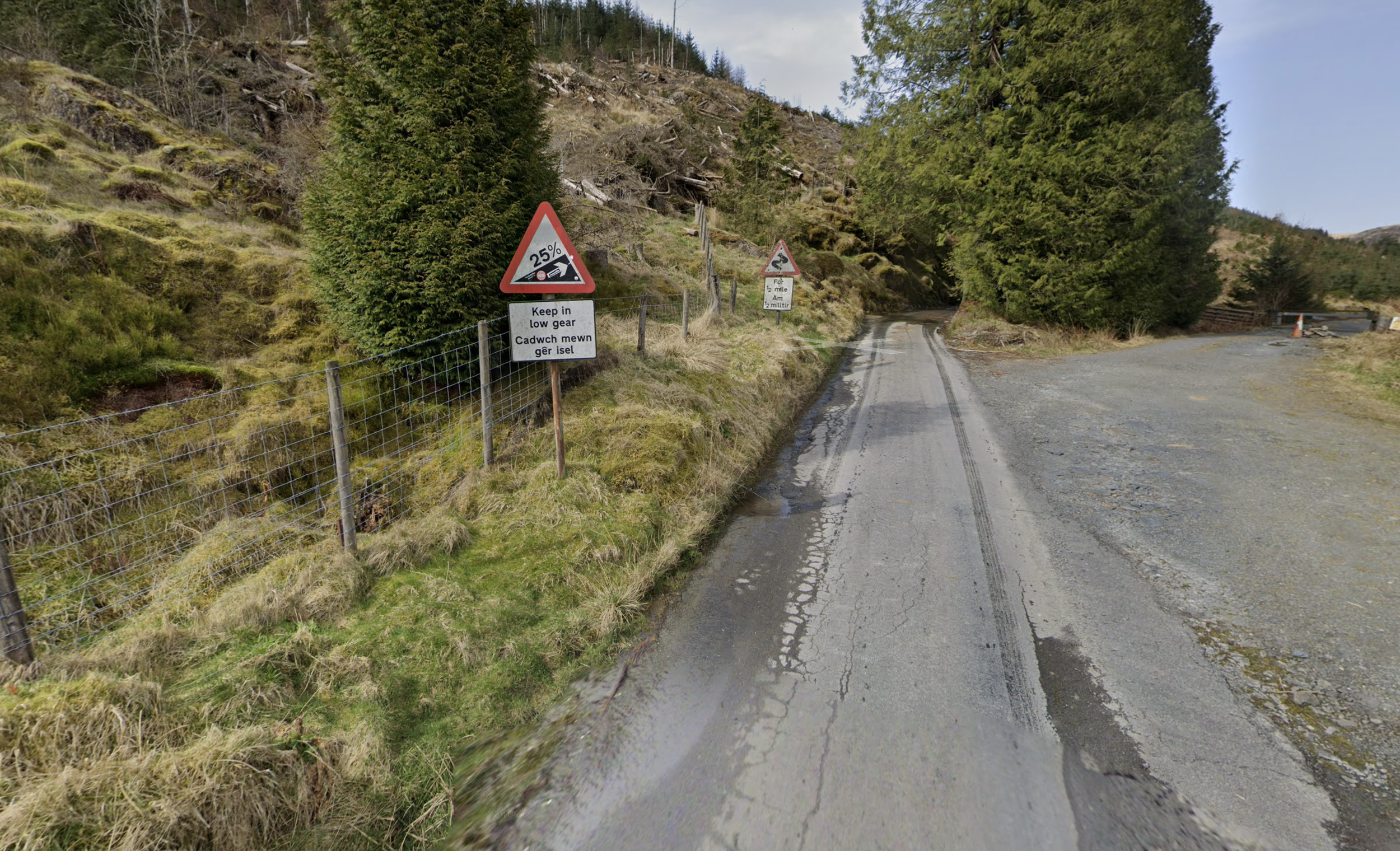
When road planners feel the need to put up a sign warning motorists to stay in a low gear, you know you're somewhere interesting on a bike.
The Devil's Staircase ascent near Llyn Brianne features gradients at 25% — and possibly steeper, because gradient signs are, if anything, conservative. The views from up there across the reservoir were genuinely stunning. There's a moment on climbs like that where the suffering and the scenery hit simultaneously and you get something that almost resembles peace. Almost.
The Suraj story
One of the best things about a small camp — we kept this to five people deliberately, for exactly the reason that you actually know each other — is watching transformation in real time.
Suraj was on camp last year. Last year, Suraj was at the back, grinding, surviving, grovelling through the climbs in the way that we've all been at some point.
This year? This year Suraj was crushing us. Attacking on the climbs, looking comfortable while the rest of us were deep in our own private suffering caves. A year of structured training produces results that are genuinely startling when you see them condensed into a side-by-side comparison with twelve months prior.
That's the thing about consistent, progressive training — the gains are real, they're just slow enough week-to-week that you can miss them. Put someone in the same environment a year apart and suddenly the improvement is impossible to ignore.
What camp actually does
People sometimes ask whether a training camp is "worth it" — whether the volume justifies the logistics and the cost of getting there.
Here's what a camp does that a normal training week doesn't: it compresses suffering into a short window, which recalibrates your sense of what hard is. After seven days in Wales, a 3-hour ride with intervals feels like a recovery day. After leaning over your handlebars at 25% just to keep from toppling backwards, your Tuesday threshold session feels almost comfortable.
That recalibration is worth a lot. It's also why we spend the camp weeks doing volume and hill work rather than highly structured interval sessions — the goal is to discover new levels of what you can endure, not to hit specific power numbers.
Oh, and the sheep. Countless sheep. Countless lambs. Not particularly relevant to the training, but very much part of the aesthetic.
Want to watch the full camp?
I filmed the whole thing on an outfront camera — raw, unfiltered, no cuts to make the climbing look easier than it was.
[Watch: 7 Days in Wales: Spring Training Camp | The Climbs, The Suffering & 24 Hours in the Saddle]
Interested in structured training that builds toward something like this?
The Collective gives you MAP-based progressive training cycles, monthly live Q&As, and a community of riders who actually train seriously — join here →
Or if you'd prefer 1-to-1 coaching with a programme built specifically around you, find out more here →